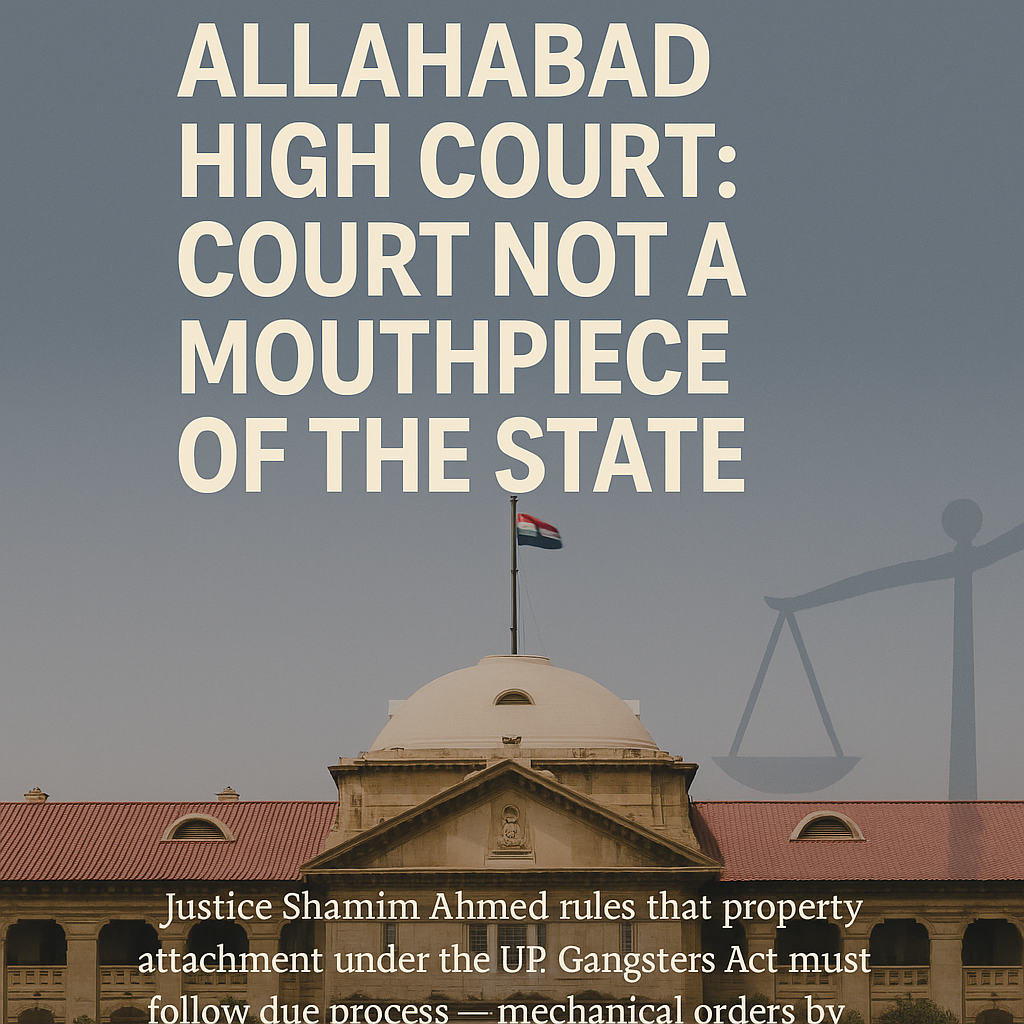
Allahabad HC on Gangsters Act Property Attachment
In a powerful reaffirmation of judicial independence and due process, the Lucknow Bench of the Allahabad High Court has held that a court cannot function as a mere “post office” or “mouthpiece” of the State or the District Magistrate while dealing with cases under the Uttar Pradesh Gangsters and Anti-Social Activities (Prevention) Act, 1986.
Delivering the ruling in Waseem Khan v. State of U.P. Thru. Prin. Secy. Nyay Lko. And Another (Criminal Appeal No. 203 of 2023, Neutral Citation No. 2023:AHC-LKO:33213), Justice Shamim Ahmed of the Allahabad High Court on May 10, 2023, quashed the orders passed by the District Magistrate, Lucknow, and the Special Judge, Gangster Act, Lucknow, which had directed the attachment of the appellant’s properties under the Gangsters Act. The court also ordered the immediate release of all the seized assets belonging to the appellant, Waseem Khan.
Background of the Case
The case originated from a series of criminal cases filed against Waseem Khan between 2012 and 2021, culminating in an FIR under Sections 2 and 3 of the Gangsters Act in 2021. Acting on this, the District Magistrate attached several properties of Khan on April 13, 2022, claiming they were purchased with proceeds of alleged anti-social activities. The order was later upheld by the Special Judge under the Gangsters Act in January 2023.
Challenging both orders, Khan approached the High Court, arguing that the attached properties were ancestral and lawfully acquired from his legitimate earnings from businesses in Mumbai and Lucknow. He contended that the District Magistrate had acted arbitrarily and without sufficient material evidence to establish that the assets were acquired through unlawful means.
Court’s Analysis and Findings
Justice Shamim Ahmed conducted a detailed examination of the statutory framework under Sections 14, 15, 16, and 17 of the Gangsters Act. The court observed that property can only be attached if it has been acquired through the commission of an offence triable under the Act, and such satisfaction must be expressly recorded by the District Magistrate based on credible evidence.
The court found that the District Magistrate had acted mechanically, relying solely on a police report without conducting an independent evaluation or recording any reasoned satisfaction. The Judge emphasized that judicial scrutiny under Section 16 of the Act exists precisely to prevent arbitrary deprivation of property by executive authorities.
In striking words, Justice Ahmed observed:
“The court is not empowered to act as a post office or mouthpiece of the State or the District Magistrate. If a person has no criminal history during the period the property was acquired by him, how can it be held that the property was acquired as a result of an offence triable under the Act?”
The court also noted that the appellant’s properties had been acquired years before the Gangsters Act case was registered against him and that no credible evidence was presented to show they were proceeds of crime. It further criticized the lower courts for failing to hold a proper inquiry or record reasons, thereby violating both statutory procedure and principles of natural justice.
Judgment and Directions
The High Court quashed both the April 13, 2022 order of attachment issued by the District Magistrate and the January 5, 2023 order passed by the Special Judge, Gangsters Act. Justice Ahmed directed the District Magistrate, Lucknow, to release all properties attached under the impugned order “forthwith” in favour of the appellant.
The judgment is a strong reminder that judicial and quasi-judicial authorities cannot act mechanically or merely endorse executive actions. It reinforces the principle that courts must function as independent arbiters, ensuring fairness, legality, and accountability in the exercise of state power.
By emphasizing that courts must conduct a genuine, evidence-based inquiry instead of rubber-stamping administrative decisions, the Allahabad High Court’s ruling sets a crucial precedent for cases involving property seizures under special laws like the Gangsters Act.
Disclaimer: This content has been produced and published by Local Law Media Network for informational purposes only. It does not constitute legal advice. The views and opinions expressed are independent and do not reflect the position of any legal practice or organization associated with the individuals mentioned.