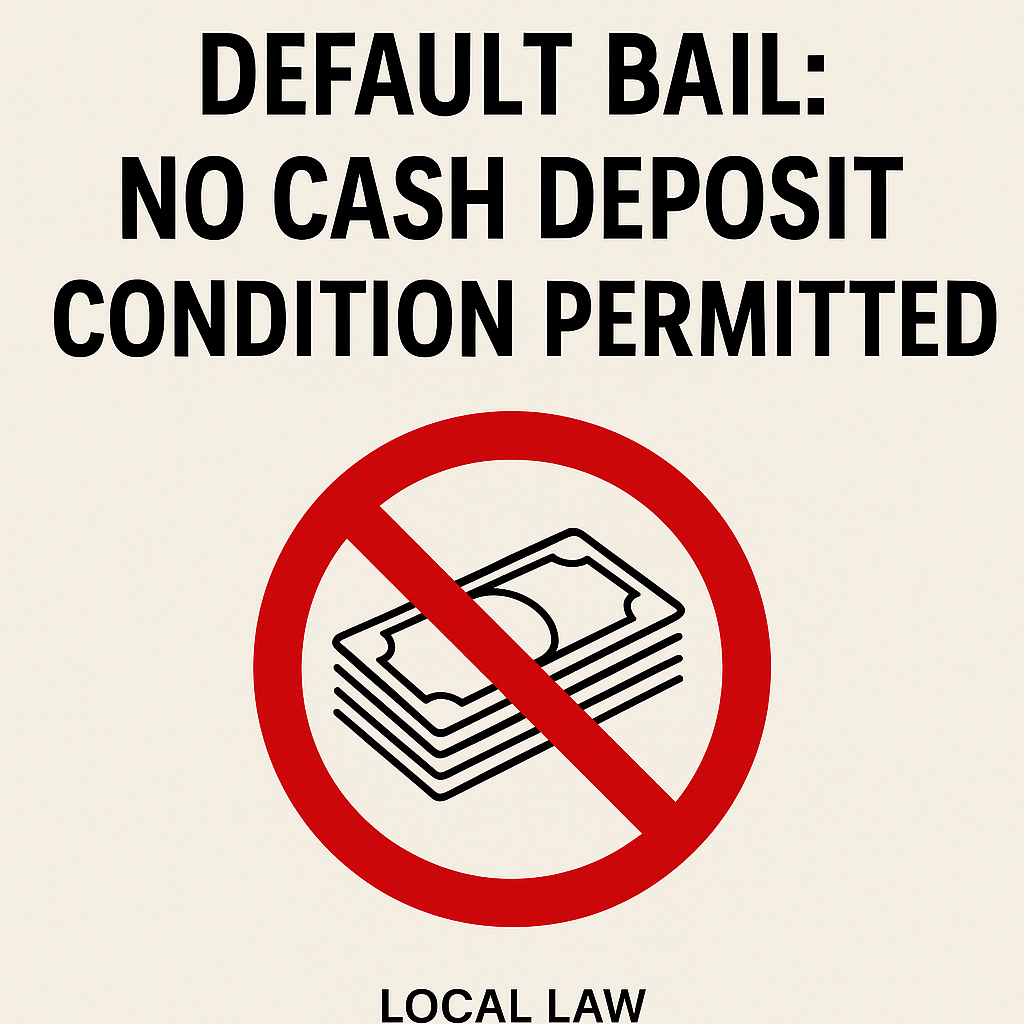
Kerala HC on default bail and cash deposit condition
In a significant reaffirmation of judicial restraint and procedural fairness, the Kerala High Court has held that Magistrates cannot impose conditions requiring cash deposits while granting statutory (default) bail. The ruling, delivered on May 30, 2023, by Justice Raja Vijayaraghavan V. in Rajesh @ Malakka Rajesh & Anr v. State of Kerala (CRL. MC No. 3385 of 2023), draws a clear red line for Magistrates, underscoring that prudence and constitutional propriety must guide their discretion.
The court’s decision arose from a challenge to an order by the Judicial Magistrate of First Class-I, Alathur, which directed two accused persons charged under Sections 406 and 420 read with Section 34 of the IPC to deposit ₹50,000 as cash security as a condition for default bail. The petitioners argued that the Magistrate had no legal basis to impose such a requirement, citing the Supreme Court’s binding precedent in Saravanan v. State represented by the Sub-Inspector of Police [(2020) 9 SCC 101].
‘Indefeasible Right’ to Default Bail
Justice Vijayaraghavan noted that the Supreme Court in Saravanan had decisively ruled against imposing monetary deposit conditions while granting statutory bail under Section 167(2) of the Code of Criminal Procedure (CrPC). The apex court had emphasized that once the statutory period of 60 or 90 days (depending on the nature of the offence) lapses without a charge sheet being filed, the accused obtains an “indefeasible right” to default bail, provided they apply for it and are prepared to furnish regular surety bail.
“The only requirement for getting default bail,” the Supreme Court had held, “is that the accused is in jail for more than 60 or 90 days, and within that period, the investigation is not completed and no charge sheet is filed. No other condition of deposit of amount can be imposed.”
Relying on this categorical position, the Kerala High Court observed that any condition requiring the deposit of money as security would “frustrate the very object and purpose of default bail.”
Citing Precedent and Correcting Error
In his detailed order, Justice Vijayaraghavan noted that the Magistrate had incorrectly relied on Sumit Mehta v. State [2013 (2) KLD 677] and Lekha v. State [2019 (3) KLJ 825] both decisions dealing with anticipatory bail, not default bail. The High Court clarified that the principles governing anticipatory bail are materially different from those governing statutory bail, which arises from a procedural right enshrined under Section 167(2) CrPC.
“The judgments relied on by the learned Magistrate were not applicable to the facts and circumstances,” Justice Vijayaraghavan wrote, before setting aside the cash deposit condition while keeping all other bail conditions intact.
Significance of the Ruling
This judgment serves as a vital reminder that judicial discretion must operate within the limits prescribed by law. The power to grant statutory bail is not a matter of grace or charity it is a legal entitlement triggered by the failure of the prosecution to file its charge sheet within the prescribed time. Adding extraneous conditions like cash deposits not only undermines that right but also introduces arbitrary financial barriers to liberty.
Legal experts note that the ruling reinforces the constitutional principle that bail jurisprudence must remain accessible, equitable, and insulated from discretionary excesses. It also reiterates the judiciary’s duty to ensure that procedural rights are not eroded by overzealous conditions that disadvantage the poor or marginalized accused.
The Kerala High Court’s reasoning aligns with the Supreme Court’s broader view in Rakesh Kumar Paul v. State of Assam [(2017) 15 SCC 67], where it had emphasized that default bail is a fundamental safeguard against prolonged detention without trial.
By restoring clarity to the scope of a Magistrate’s powers, the judgment ensures that the right to default bail remains what it was meant to be an enforceable protection, not a privilege contingent on one’s financial capacity.
Disclaimer: This content has been produced and published by Local Law Media Network for informational purposes only. It does not constitute legal advice. The views and opinions expressed are independent and do not reflect the position of any legal practice or organization associated with the individuals mentioned.
