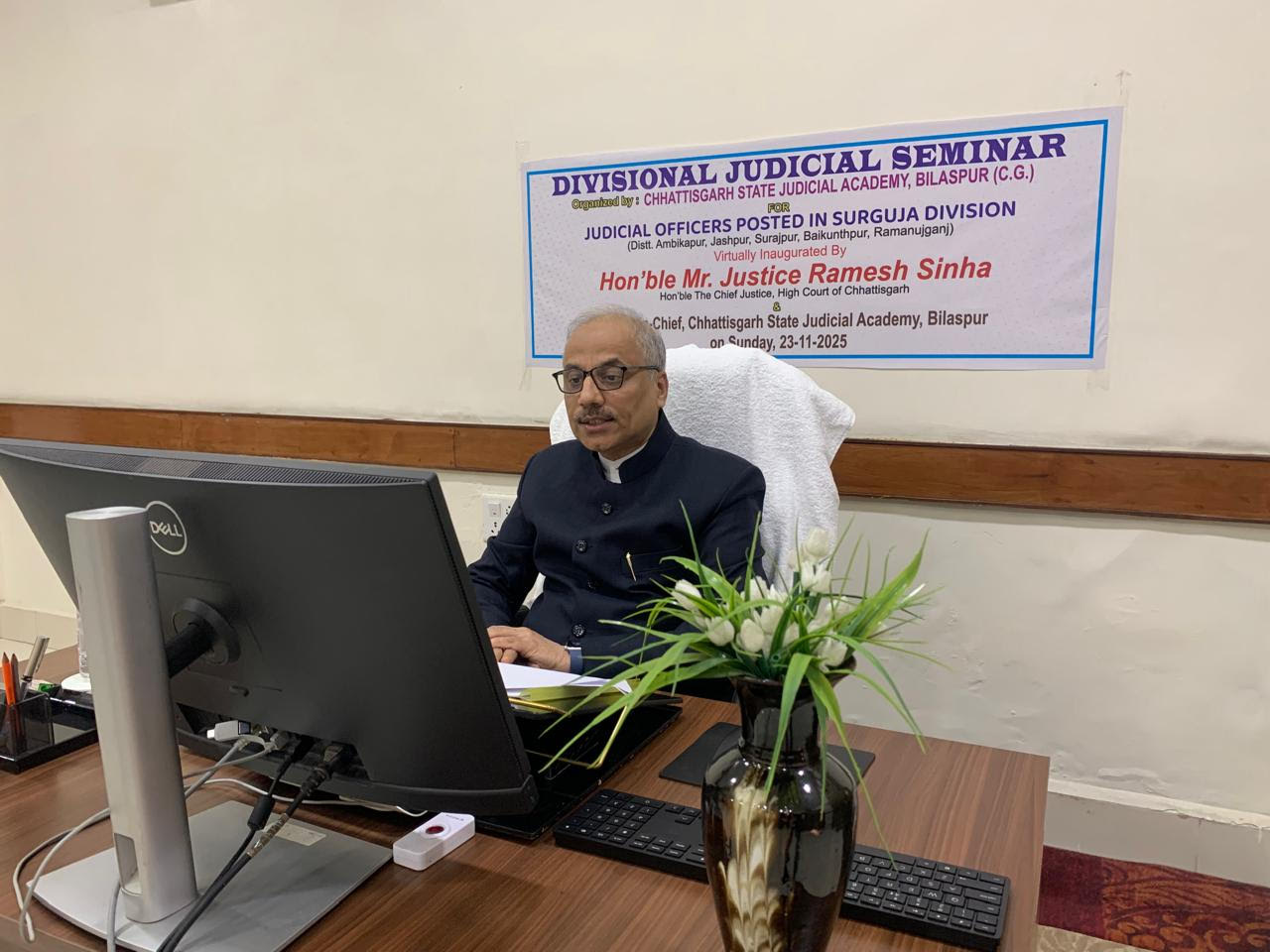
A one-day Divisional Judicial Seminar for Judicial Officers of Surguja Division was organized by the Chhattisgarh State Judicial Academy at the Conference Hall, Circuit House New Building, Ambikapur. The seminar was attended by 69 Judicial Officers from Five Civil Districts of the Surguja Division ((Ambikapur, Baikunthpur, Jashpur, Balrampur at Ramanujganj, Surajpur)). The Chief Guest, Hon’ble Mr. Justice Ramesh Sinha, Chief Justice, High Court of Chhattisgarh & Patron-In-Chief Chhattisgarh State Judicial Academy, virtually inaugurated the seminar. This ceremonial moment symbolized the illumination of Justice and legal wisdom. The seminar was also graced by the virtual presence of Hon’ble Mr. Justice Radhakishan Agrawal, Judge, High Court of Chhattisgarh & Portfolio Judge, District Surajpur, Hon’ble Mr. Justice Ravindra Kumar Agrawal, Judge, High Court of Chhattisgarh & Portfolio Judge, District Jashpur & Hon’ble Mr. Justice Arvind Kumar Verma, Judge, High Court of Chhattisgarh & Portfolio Judge, District Balrampur-Ramanujganj.
Chief Justice Ramesh Sinha inaugurated the seminar online. During his address, he reminded the judges that “justice is not done merely by systems and procedures; it flows from the conscience of the judge.” He said the judiciary is the foundation of India’s constitutional democracy, and people experience it most directly in district and taluka courts. He added that a judge’s conduct, decisions and overall approach strongly influence how the public views the justice system.ustice itself.
Hon’ble the Chief Justice highlighted that District Judiciary faces many changing and diverse challenges, such as rising numbers of cases, new technology and the increasing complexities of disputes in society. To address these realities, Judges must develop a Judiciary that is knowledge- driven, ethically grounded, and sensitive to the needs of society.
Hon’ble the Chief Justice emphasized that Justice is not done merely by systems and procedures; it flows from the conscience of the Judge. Every litigant who walks into your Courtroom must leave with the impression that they have been heard and their matters have been adjudicated with fairness.
Hon’ble the Chief Justice urged all the Judicial Officer that Judiciary’s greatest strength lies in the trust of the People. It is Judge’s duty to honour that trust by upholding the highest standards of integrity, discipline, and Judicial ethics. When Judges remain committed to the rule of law and guided by the values of our Constitution, the Judiciary stands unshakable.
In conclusion, Hon’ble the Chief Justice wished that Seminars such as this one provide a valuable opportunity to deliberate on contemporary legal issues, exchange experiences, and adopt best practices. The deliberation during the seminar will enhance Judicial Officer’s professional skills and equip them to handle the complexities of Judicial work with greater efficiency.
The event was virtually attended by Registrar General, High Court of Chhattisgarh, Registry Officers. Welcome address was delivered by Principal District & Sessions Judge Ambikapur and Introductory address was given by Director of Chhattisgarh Judicial Academy & concluded with a vote of thanks by Ist District & Additional Sessions Judge Ambikapur
A total of 69 Judicial Officers from Surguja Division-District (Ambikapur, Baikunthpur, Jashpur, Balrampur at Ramanujganj, Surajpur)- participated. The participants gave presentations on the following subjects-
- The absent accused and the added accused- Analysing the procedural overlap between trial in absentia under Sec 356 BNSS and Sec 358 BNSS.
- Doctrine of Specific Performance of Contract-Law and Procedure with special reference to recent Apex Court’s Pronouncement and explained by means of illustration of a civil suit. Limitation on the availability of Specific Performance.
- The Doctrine of Competency of Court under Order 7 Rule 10 CPC. The Power To Reject A Plaint At The Threshold Under Order 7 Rule 11 CPC- A Judicial Duty Or Discretionary Power.
- Provisions relating to arrest, remand and bail with reference to guidelines issued by Hon’ble Supreme Court in Satender Kumar Antil vs. CBI and Siddharth vs. State of U.P. and provisions relating to disposal of property in criminal cases.
- Execution of Decree by arrest and detention in the civil prison and attachment of property. Strategies for timely and efficient enforcement.
