Why India Must Rethink and Consider Abolishing Life Imprisonment
“Life imprisonment means behind bars for life. It is worse than death to keep a person confined for his entire life in jail rather than taking his life.” That was Justice V.R. Krishna Iyer’s blunt verdict on a punishment most of us accept without question. Yet his challenge why has society resisted calls to abolish life imprisonment with the same energy that campaigns against the death penalty attract deserves renewed attention.
India’s penal landscape treats life sentences as if they were the default maximum for the worst crimes. Unlike capital punishment, which is imposed rarely and debated widely, life imprisonment is sprinkled across statutes and handed down with mechanical regularity. Over decades the meaning of “life” has hardened: where earlier practice sometimes treated a “life” term as a definable number of years, modern judicial and administrative practice increasingly allows life to read literally daily confinement until death unless the state chooses otherwise. That reality ought to trouble us.
There are three interlocking reasons to re-examine life imprisonment today.
First, the moral paradox. If death is the most extreme sanction and a matter of electrifying public debate, why do we quietly accept an alternative that, in practice, may inflict a slower, crueller extinction of personhood? Prolonged incarceration fractures family ties, exhausts financial and emotional support networks, and can turn a human being into a social non-entity long before the formal extinguishing of life. The claim that life imprisonment is “worse than death” is not rhetorical flourish; it points to the lived, often invisible suffering of those consigned to prisons for decades. A penitent or reformed person loses years of life that can never be returned. Our legal system should reckon with that loss.
Second, the case for rehabilitation. Justice Krishna Iyer championed the belief that “every sinner has a future.” Empirical evidence from many jurisdictions shows people change: education, therapy, vocational training, restorative justice programs and structured re-entry support reduce recidivism and reclaim social value. India’s prisons are hardly factories of reform now, but that is an argument for investment and systemic change not for a default punishment that shuts off the possibility of redemption. The rare instances where prisoners have transformed dramatically even those involved in political violence or terrorism suggest the state should design pathways, not permanent exclusions.
Third, the incoherence of policy. Legislatures and courts routinely attach life imprisonment to an expanding list of offences, while the public conversation obsessively circles capital punishment. If the aim is proportionality, public safety and rehabilitation, a law that consigns people to perpetual confinement without a structured pathway out is a blunt instrument that fails every test. Sentencing should be principled: specifying maximum terms, mandatory periodic reviews, and a statutory framework for conditional release tied to demonstrable rehabilitation. That would preserve punishment’s deterrent and retributive aspects while restoring hope and practical second chances.
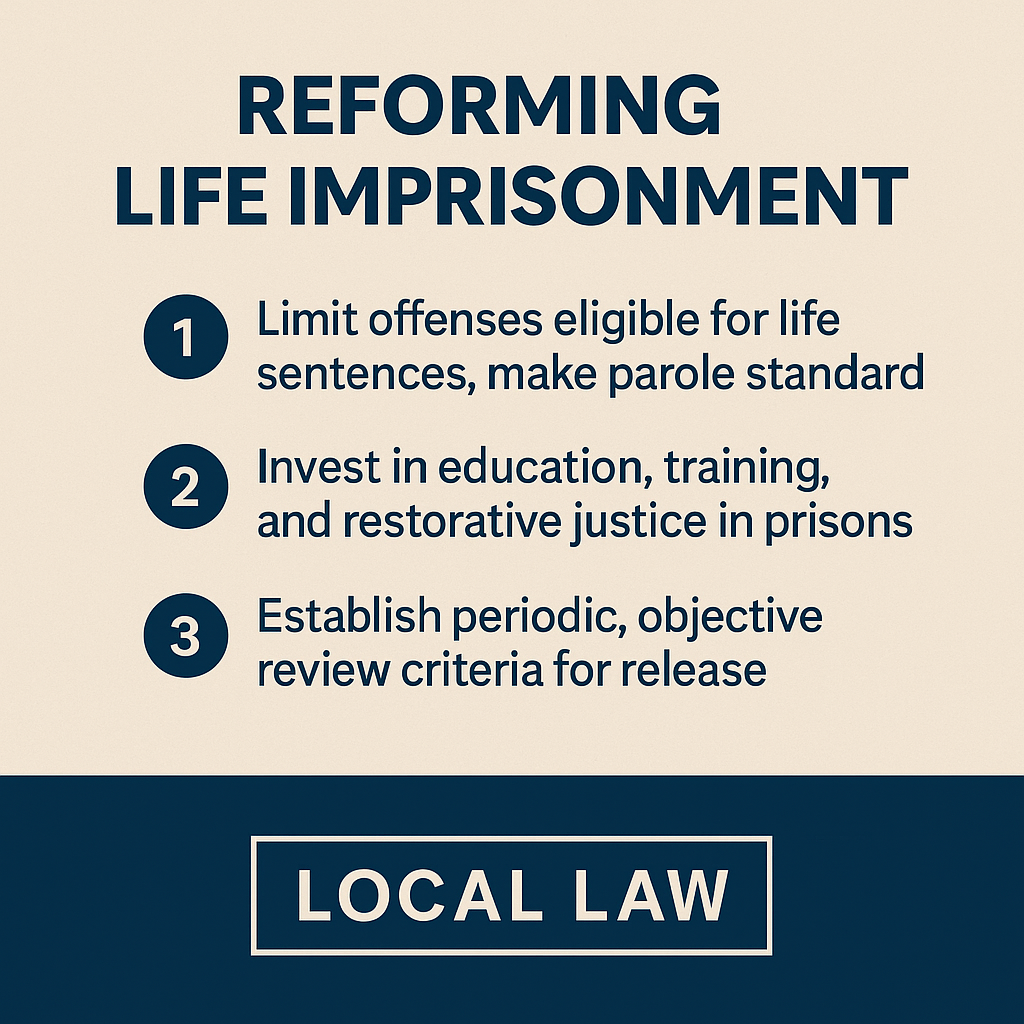
Practical reforms and ultimately abolition need not be reckless. A phased approach makes sense. First, limit offences that carry literal life terms to a very short list of exceptional crimes, and make long-term imprisonment rare and exceptional rather than routine. Second, mandate regular, transparent parole or review mechanisms within a set timeframe (for example, review after 10–15 years with clear, objective criteria). Third, invest in in-prison education, vocational training, restorative justice programs, and post-release support to reduce recidivism and ease reintegration. Fourth, ensure victims’ voices are heard and restorative processes are available reform must balance accountability with societal rehabilitation.
Objections will be immediate and loud. Some will say that certain crimes are so grave that society must ensure the wrongdoer never walks free. That impulse is understandable; citizens want safety and closure. But there is an important distinction between protecting society and permanently erasing a person’s future. Prudent design can reconcile both: an offender who has demonstrated genuine rehabilitation remains under supervision and is subject to restrictions tailored to the risk posed, while those who remain dangerous are lawfully detained under rigorous review. The state’s authority to deprive liberty is not absolute; it must be exercised with proportionality, fairness and a view toward restoring, not extinguishing, human dignity.
Law reform bodies the Law Commission and legislative drafters must examine the proliferation of life terms across statutes. Just as the death penalty has been the subject of repeated public and institutional scrutiny, life imprisonment deserves structured, evidence-based review. Human-rights groups, criminologists, penologists, victim groups and lawmakers should join a national conversation about punishment’s purpose in a modern democracy: is it purely retributive, or should it also be corrective and restorative?
If India truly draws on the moral wellsprings of its philosophical and religious traditions ideas of forgiveness, transformation and the sanctity of life then consigning persons to unending penury of liberty needs a far stronger justification than habit, fear or political convenience. Justice Krishna Iyer’s challenge remains: a civilized polity should ask whether the state should be in the business of extinguishing futures by decree.
Abolishing or radically reforming life imprisonment won’t be easy. It will require political will, social debate, and the design of robust alternatives that protect victims and the public. But it is a debate worth having. If the measure of a society is how it treats those it punishes, then rethinking life sentences is not a luxury: it is a test of our commitment to justice, humanity and the possibility of redemption.



