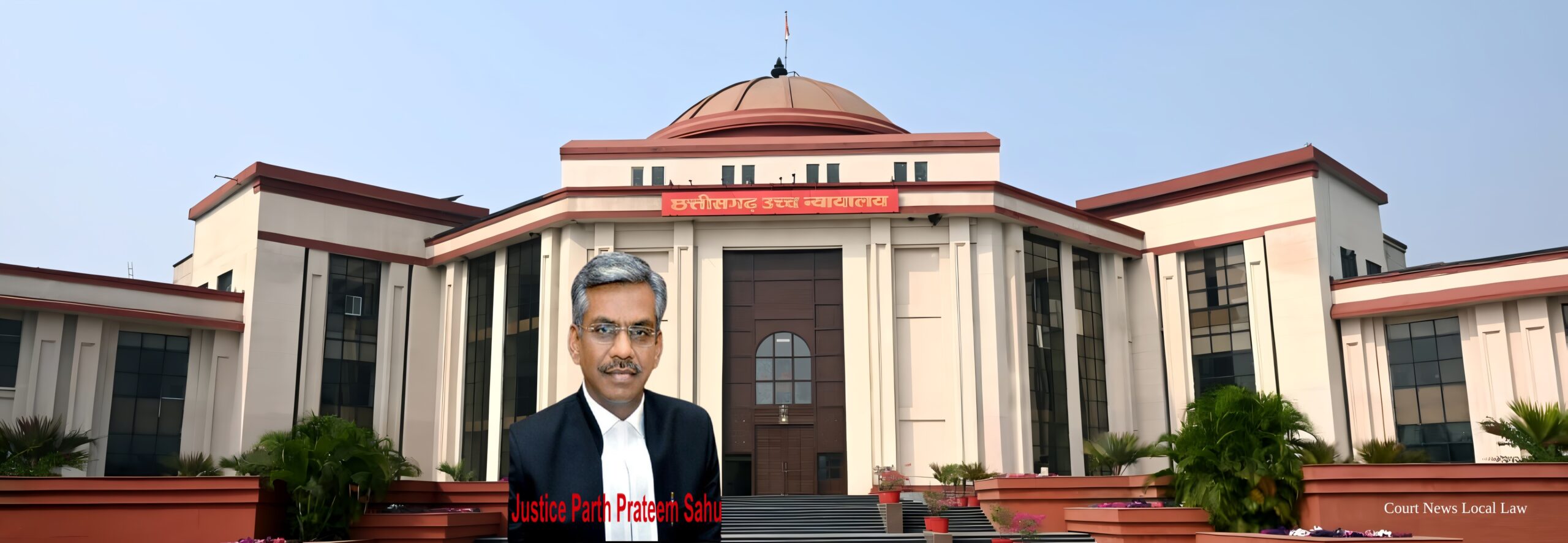
The Chhattisgarh High Court has asked the District Education Officer (DEO) in Bilaspur to take a fresh call on a long-pending claim for reimbursement of funds under the Right to Education (RTE) quota, after a Bilaspur school approached the court over unpaid dues of more than ₹21 lakh.
On 28 November 2025, Justice Parth Prateem Sahu disposed of Writ Petition (Civil) No. 6224 of 2025, filed by Bharat Mata English Medium Higher Secondary School, R.S. Bilaspur, and Bharatmata Vidhya Sangh, which runs the school through Sacred Heart Church in Bilaspur. The petitioners had moved the High Court against the State of Chhattisgarh and its school education authorities, seeking reimbursement for free education provided to students admitted under the RTE quota.
According to the petition, the school claimed that a total of ₹21,07,000 was pending towards reimbursement for the academic years 2020–21 to 2024–25. This amount, they said, represents expenditure incurred for educating children admitted under the mandatory 25 percent RTE quota in private unaided schools. The petitioners also sought interest at 6 percent per annum on the delayed payment, as well as directions to ensure timely reimbursement in future years as long as those RTE students continue in the institution.
Court focuses on representation, not on merits
During the hearing, counsel for the school argued that the institution has been regularly providing education under the RTE framework, but despite submitting representations to the authorities, the reimbursement claims remained unaddressed. On that basis, the petitioners asked the High Court to issue a writ of mandamus directing the State to clear the pending dues and to streamline future payments.
However, instead of deciding the reimbursement claim on merits, the court chose a limited course of action. The school’s counsel expressed willingness to restrict the prayer to a direction for consideration of a fresh, detailed representation. Counsel for the State did not object to this limited relief and assured that any representation submitted would be considered in accordance with law.
Taking note of this stand, the court permitted the petitioners to file a fresh representation before the DEO, Bilaspur, who is Respondent No. 3 in the case. Justice Sahu directed that if such a representation is filed, the DEO must consider and decide it expeditiously, preferably within 60 days from the date of receipt, and in accordance with applicable law and policy. With these directions, the writ petition was disposed of.
What the order means for the school and similar institutions
The High Court’s order does not itself grant the reimbursement amount of ₹21,07,000 or interest. Instead, it pushes the decision back to the administrative authority, but with a clear time frame. For Bharat Mata English Medium Higher Secondary School, this means the next crucial step is to prepare and file a comprehensive representation, documenting the number of students admitted under the RTE quota, the corresponding expenditure, and the relevant approvals or records for each academic year in question.
Although the outcome is procedural rather than substantive, the order offers the petitioners a structured route to press their claim. The direction to decide the representation “expeditiously” and “preferably within 60 days” provides some assurance against indefinite delay. If the DEO rejects or only partly allows the claim, the petitioners would still retain the option of challenging that decision in accordance with law.
For other private schools providing free education under the RTE quota, the case underlines a familiar tension: while the law obliges them to reserve seats without charging fees, the viability of this model depends heavily on timely reimbursement from the government. When payments are delayed for several academic years, schools often say it strains finances and affects their ability to maintain standards. Orders like this one highlight that courts may prefer to first insist on proper administrative consideration of such claims, rather than directly stepping into the role of assessing amounts due.
Administrative accountability in RTE reimbursement
The case also reflects a broader pattern in education litigation, where courts seek to balance judicial restraint with administrative accountability. By directing the DEO to decide the representation within a specific window, the High Court has effectively reminded the education department that reimbursement claims under the RTE framework cannot be kept in limbo.
If the DEO’s eventual decision is reasoned and grounded in records, it may also help clarify any disputes on the number of eligible students, per-child costs, or procedural compliance under the RTE scheme. For stakeholders, including parents, managements and regulators, such clarity is critical to sustaining trust in the implementation of the Right to Education Act at the ground level.
In the immediate term, the spotlight will be on the DEO, Bilaspur, to process the school’s claim for the five academic years from 2020–21 to 2024–25 and to communicate a speaking order within the period indicated by the court. The future of this particular reimbursement dispute, and possibly similar pending claims, will turn on how rigorously that direction is followed.
